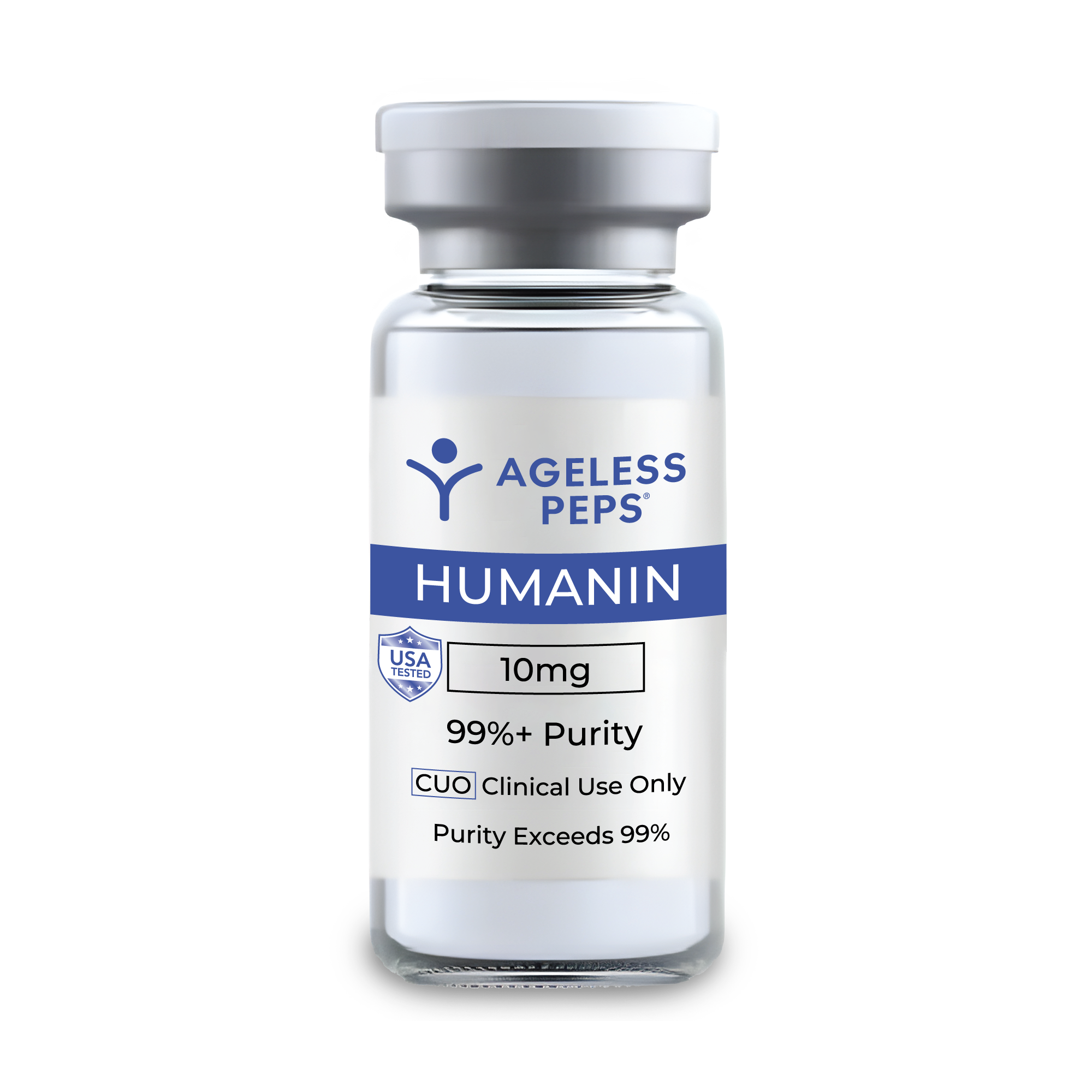

$60.00
Humanin is a 24-amino-acid mitochondria-derived peptide (MDP) encoded within the mitochondrial 16S rRNA gene. Originally discovered for its ability to protect neurons from amyloid-β toxicity, Humanin signals through both intracellular (Bax, IGFBP-3) and extracellular (CNTFR/WSX-1/gp130) pathways to promote cytoprotection and metabolic regulation.
In aging, neuroscience, and metabolic research, Humanin is studied for its potential role in neuroprotection, Alzheimer’s disease pathology, insulin sensitivity, mitochondrial stress signaling, and cellular senescence. It is a central molecule in preclinical investigations of mitochondrial-derived peptide biology and age-related functional decline.
$60.00
Available on backorder
Humanin is a 24-amino-acid mitochondria-derived peptide (MDP) encoded within the 16S ribosomal RNA gene of the mitochondrial genome. First identified in a cDNA library screen for factors that protect neurons from amyloid-β toxicity, Humanin has since emerged as a critical endogenous cytoprotective molecule. It signals through two distinct pathways: intracellularly via interaction with Bax and IGFBP-3, and extracellularly through the trimeric CNTFR/WSX-1/gp130 receptor complex. Humanin is a major focus in preclinical research on aging, metabolic regulation, and cellular stress resistance.
Note: The following observations are derived from preclinical models unless otherwise noted.
1. Neuroprotection and Alzheimer’s Disease Models Humanin was originally discovered for its ability to protect neurons from amyloid-β-induced cytotoxicity. In transgenic mouse models of Alzheimer’s disease, Humanin analogs have been shown to reduce amyloid plaque burden, improve spatial memory, and attenuate neuroinflammation. The neuroprotective mechanism involves direct binding to Bax protein, preventing its translocation to the mitochondrial membrane and subsequent apoptotic cascade activation.
2. Metabolic Regulation and Insulin Sensitivity In animal models of diet-induced obesity and type 2 diabetes, Humanin administration has demonstrated improvements in peripheral insulin sensitivity and glucose homeostasis. Studies indicate the peptide modulates IGFBP-3 signaling, enhancing IGF-1 bioavailability and supporting pancreatic β-cell survival under glucotoxic and lipotoxic conditions. Circulating Humanin levels have been shown to decline with age in animal models.
3. Mitochondrial Stress Response and Cellular Senescence Humanin is investigated as a retrograde signaling molecule that communicates mitochondrial stress status to the cytoplasm and nucleus. In vitro studies demonstrate that Humanin attenuates reactive oxygen species (ROS) production, preserves mitochondrial membrane potential under oxidative challenge, and reduces markers of cellular senescence including p16 and SA-β-galactosidase expression in aged cell populations.
4. Clinical Research (Human Observational Studies) While no interventional clinical trials of exogenous Humanin administration have been completed, significant human observational and biomarker data exist. Plasma Humanin levels decline progressively with age in human populations, and notably, children of centenarians exhibit higher circulating Humanin levels than age-matched controls, suggesting a correlation with exceptional longevity (Journal of Clinical Investigation, Muzumdar et al.). In disease-specific studies, patients with Alzheimer’s disease show reduced Humanin levels that inversely correlate with disease severity and cognitive decline. Patients with type 2 diabetes exhibit lower circulating Humanin compared to metabolically healthy controls, with levels correlating inversely with insulin resistance markers (HOMA-IR). In cardiovascular disease populations, reduced Humanin levels associate with increased cardiovascular risk and adverse outcomes. Humanin has been identified as an impaired fasting glucose-related oxidative stress biomarker in human subjects (Voigt et al., Physiological Reports, 2016). These observational findings position Humanin as both a potential biomarker for age-related disease risk and a candidate for future interventional clinical studies.
Our products are made using a freeze-drying (lyophilization) process, which helps keep them stable during shipping for up to 3–4 months.
When the peptide is in its dry powder form, it can be stored at room temperature until you are ready to use it.
Once the peptide is mixed with bacteriostatic water (reconstituted), it should be stored in the refrigerator to maintain freshness and effectiveness. After mixing, the peptide will remain stable for up to 30 days when kept refrigerated.
Freeze-drying works by removing moisture while the peptide is frozen, leaving behind a dry, white powder that stays stable until it is rehydrated. This process helps protect the peptide and extend its shelf life.
After receiving your order, keep peptides away from direct light and heat. If you plan to use them within a few weeks or months, refrigeration below 4°C (39°F) is recommended, though short-term room-temperature storage is generally acceptable for dry peptides.
For long-term storage (several months to years), peptides should be kept in a freezer at −80°C (−112°F) to best preserve their quality and stability.
No COA available for this product.
Important: All peptides offered are intended for in-vitro and pre-clinical research only. Not for human use. Not approved by the US FDA for medical conditions.
Peptides are short chains of amino acids, typically under 50 residues, whereas proteins are much longer and fold into complex structures.
Because peptides are smaller, they tend to:
Bind more selectively to receptors
Have faster biological signaling effects
Be easier to synthesize and modify for research
This makes them ideal for targeted experiments in regeneration, metabolism, and cellular communication.
Ageless Pep provides high-purity, lab-tested research peptides.
The team is dedicated to scientific accuracy and excellent customer support.
The platform serves a community of researchers and scientists committed to innovation.
Depending on the study design, peptides can be researched through:
In-vitro assays
Animal models
Cell cultures
Subcutaneous or intravenous administration (in animals)
Each peptide behaves differently — for example, Semaglutide and Tirzepatide are studied via subcutaneous injections, while others like BPC-157 show effects even when administered orally or parenterally in rodent studies.
Peptides generally require:
Cool, dry storage when lyophilized
Refrigeration after reconstitution
Protection from UV light and temperature fluctuations
This preserves molecular integrity, preventing oxidation or breakdown of amino-acid chains.
Proper storage ensures reproducibility of experimental results.
Our products are made using a freeze-drying (lyophilization) process, which helps keep them stable during shipping for up to 3–4 months.
When the peptide is in its dry powder form, it can be stored at room temperature until you are ready to use it.
Once the peptide is mixed with bacteriostatic water (reconstituted), it should be stored in the refrigerator to maintain freshness and effectiveness. After mixing, the peptide will remain stable for up to 30 days when kept refrigerated.
Freeze-drying works by removing moisture while the peptide is frozen, leaving behind a dry, white powder that stays stable until it is rehydrated. This process helps protect the peptide and extend its shelf life.
After receiving your order, keep peptides away from direct light and heat. If you plan to use them within a few weeks or months, refrigeration below 4°C (39°F) is recommended, though short-term room-temperature storage is generally acceptable for dry peptides.
For long-term storage (several months to years), peptides should be kept in a freezer at −80°C (−112°F) to best preserve their quality and stability.
Scan the QR code or tap the button to apply for clinical-use-only wholesale pricing. Approval is fast and free.
Register as Wholesale →Continuing education and clinical training on peptide therapeutics. Sharpen your protocols and get certified.
Visit the Academy →