Everything your clinic needs to run a peptide program that pays.
99%+ pure, US-tested peptides at true wholesale pricing — with a COA on every batch, ready-to-use protocols, and a rep who has your back. Apply free in two minutes.
- ✓ Free to apply
- ✓ No minimums
- ✓ No account fees
- ✓ Cancel anytime
- Compound
- BPC-157 / TB-500
- Purity (HPLC)
- 99.3%
- Identity (MS)
- Pass
- Sterility
- Pass
- Manufactured
- USA
Buy at wholesale. Offer it in your clinic. Keep the margin.
Peptides are one of the highest-margin lines a modern practice can add — if your sourcing is clean and your protocols are ready. We give you both, so the program pays from the first order.
Real wholesale pricing
Your clinic pays clinical-use pricing across 80+ compounds — not the marked-up rates patients see everywhere else.
A program patients trust
A COA on every batch and clinician-reviewed protocols mean you can evaluate and offer these within your clinical judgment and charge for expertise, not guesswork.
Healthy margin on every vial
The gap between wholesale in and patient-price out is yours. No minimums and no fees mean the math works even on day one.
Example uses a single compound (GLP-3RT / Triple G™, 12-week vial). You set your patient pricing — see your exact margin, per patient and per full cycle, in the interactive calculator below.
Everything a peptide program needs — sourcing, proof, and support in one place.
You're not just buying vials. You're standing behind what goes into your patients. We built the account around that responsibility.
A COA on every batch
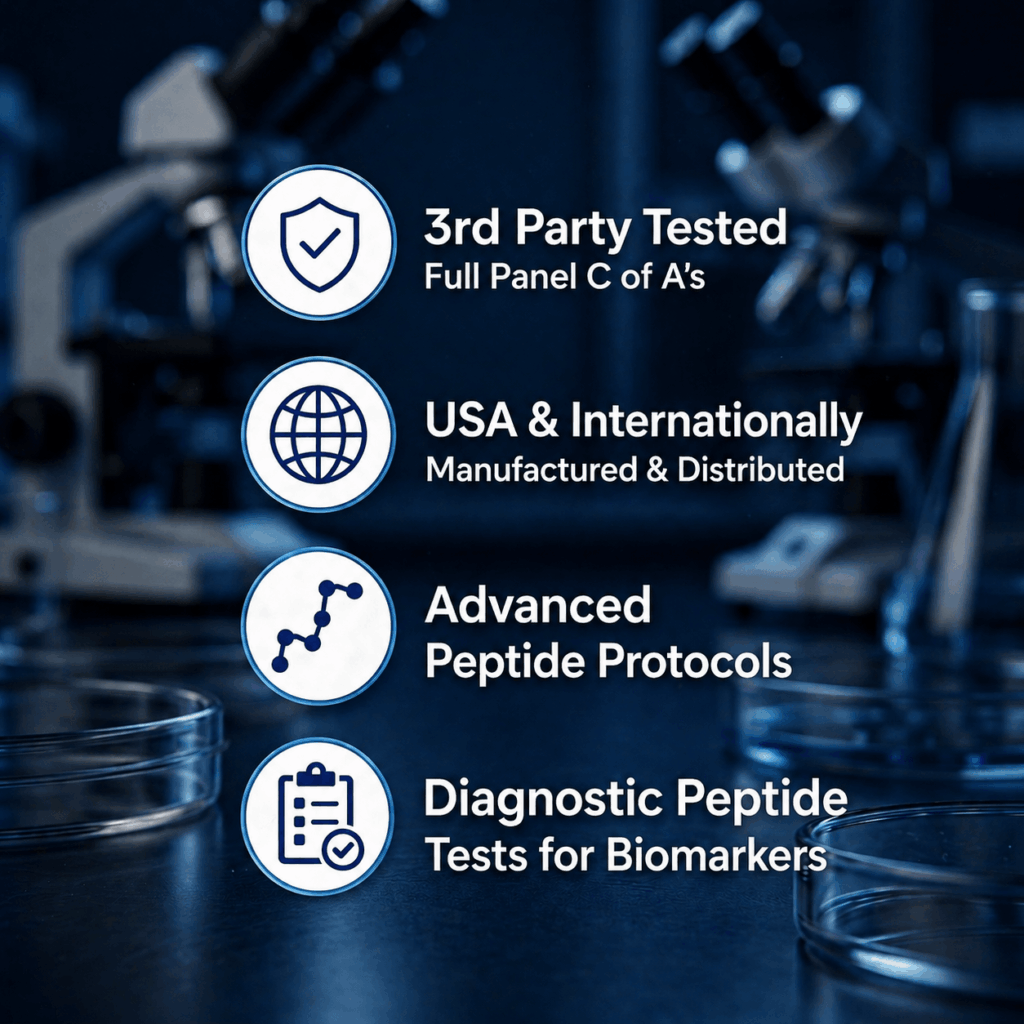
Identity, purity, and sterility — triple third-party tested in ISO-certified U.S. labs, available for every lot you order. Nothing ships on trust alone.
◆ Documentation your medical director will acceptClinician-reviewed protocols
Dosing ladders, reconstitution SOPs, and consent + COA templates, ready to use. Run a peptide line without reinventing the paperwork.
◆ Ready-to-use clinical paperworkA rep, not a ticket queue
Every approved clinic gets an assigned account rep who knows your protocols, helps with sourcing, and answers when you need a straight answer fast.
◆ Direct line, real personBuilt to grow your practice
Access Pepteon Academy education and practice playbooks so your team can offer these within your clinical judgment and expand the program — not just restock it.
◆ Education + playbooks includedBest-in-class wholesale pricing — down to the milligram.
Compare us on what actually matters: real clinic wholesale pricing on real products. Prices below are pulled live from our catalog and grouped by clinical use-case; your full wholesale price sheet — 80+ compounds — opens the moment you're approved.
Recovery & repair
- GHK-Cu (Copper) 50 mg$35
- BPC-157 10 mg$41
- GLOW 50/10/10 mg$73
Muscle, metabolic & weight
- 5-Amino-1MQ 10 mg$27.75
- Sermorelin 10 mg$39
- CJC-1295 / Ipamorelin 5/5 mg$35.25
Longevity & cellular
- Epitalon 10 mg$52
- NAD+ 1000 mg$72
- MOTS-C 10 mg$41
Cognitive & mood
- Semax 10 mg$26.25
- Selank 10 mg$24.75
- Oxytocin 10 mg$33
Free shipping over $1,000 · flat rates from $9.95 · No MOQs
See the return on a real clinic pack.
Pick a pack, set what you charge each patient, and watch the return. Once you're approved, the same calculator runs on your real, live wholesale price.
See what a clinic pack earns you
Pick the pack and set what you charge each patient per month. We do the math from your wholesale cost.
Select a pack to begin.
Preview uses current pack pricing and typical cycle length. Approved clinics see their exact live wholesale price. Patient pricing is what you set — you control the margin. For clinic use only; not a revenue guarantee.
Ageless Peptides Partner Benefits
Clinics don't switch for a slightly lower price. They switch because everything is easier — the proof, the protocols, and the person who answers.
Purity isn't a marketing word here. It's a document.
The reason clinics leave their old supplier for us is simple: when a patient or a board asks what's in the vial, you have the paper to answer.
- 99%+ purity by HPLC, verified per lot — not per product line.
- Produced in ISO-certified, cGMP-compliant facilities (US & international partners) and US-tested per lot, lyophilized for stable shelf life.
- Triple third-party tested for identity, purity, and sterility.
Apply – Get Approved – Order All in One Day.
No lengthy onboarding, no sales gauntlet. Verify your credentials, get approved, start ordering.
Apply
Tell us about your clinic. Two minutes — no upfront commitment, no fees.
Get approved in ~24 hrs
We verify credentials Monday–Friday and open your wholesale account, usually within a business day.
Order, with support
Your rep introduces themselves, shares protocols and the full price sheet, and helps you place a first order that fits your program.
Built for licensed medical practices.
Who qualifies
- Licensed physicians (MD/DO), nurse practitioners, and physician assistants
- Medical spas & wellness clinics operating under a licensed medical director
- Licensed practitioners and clinics buying for in-office patient care
- Practice credentials verified at signup — usually within one business day
Wholesale accounts are approved for licensed practitioners and clinics only.
What your account includes
- No minimum order quantities, ever
- Free shipping on orders over $1,000 — flat tiered rates from $9.95 below that
- COA access for every lot you purchase
- Assigned rep + clinician protocol library
Clinical use only. Products are supplied for licensed practitioner use.
Answers before you apply.
How fast can we actually start ordering?
Do you really provide a COA for every batch?
Is there a minimum order or account fee?
Can you help us actually run a peptide program?
Know another clinic? Refer them — and earn.
Join our partner program and earn 10% commission on the wholesale orders of every clinic you refer — not just their first order. Free to join, tracked automatically, paid out to you.
Apply free to join
Takes a minute. Once approved you get your own referral link — no fees, no minimums, no commitment.
Share your link
Send it to peers, colleagues, and clinics in your network. Every clinic that signs up and orders through your link is credited to you.
Get paid
Earn 10% on their orders, paid out via Stripe or PayPal. Track every referral, click, and payout in your partner dashboard.
- ✓ Free to join
- ✓ 10% commission
- ✓ Paid via Stripe or PayPal
- ✓ Cancel anytime
Open your clinic's wholesale account.
Two minutes to apply. Approval in about a day. A supplier you can finally stand behind.
No fees · No minimums · Clinical use only