
Free Shipping Orders Over $399 Free Shipping Orders Over $399 Free Shipping Orders Over $399 Free Shipping Orders Over $399 Free Shipping Orders Over $399 Free Shipping Orders Over $399 Free Shipping Orders Over $399 Free Shipping Orders Over $399 Free Shipping Orders Over $399

$59.00

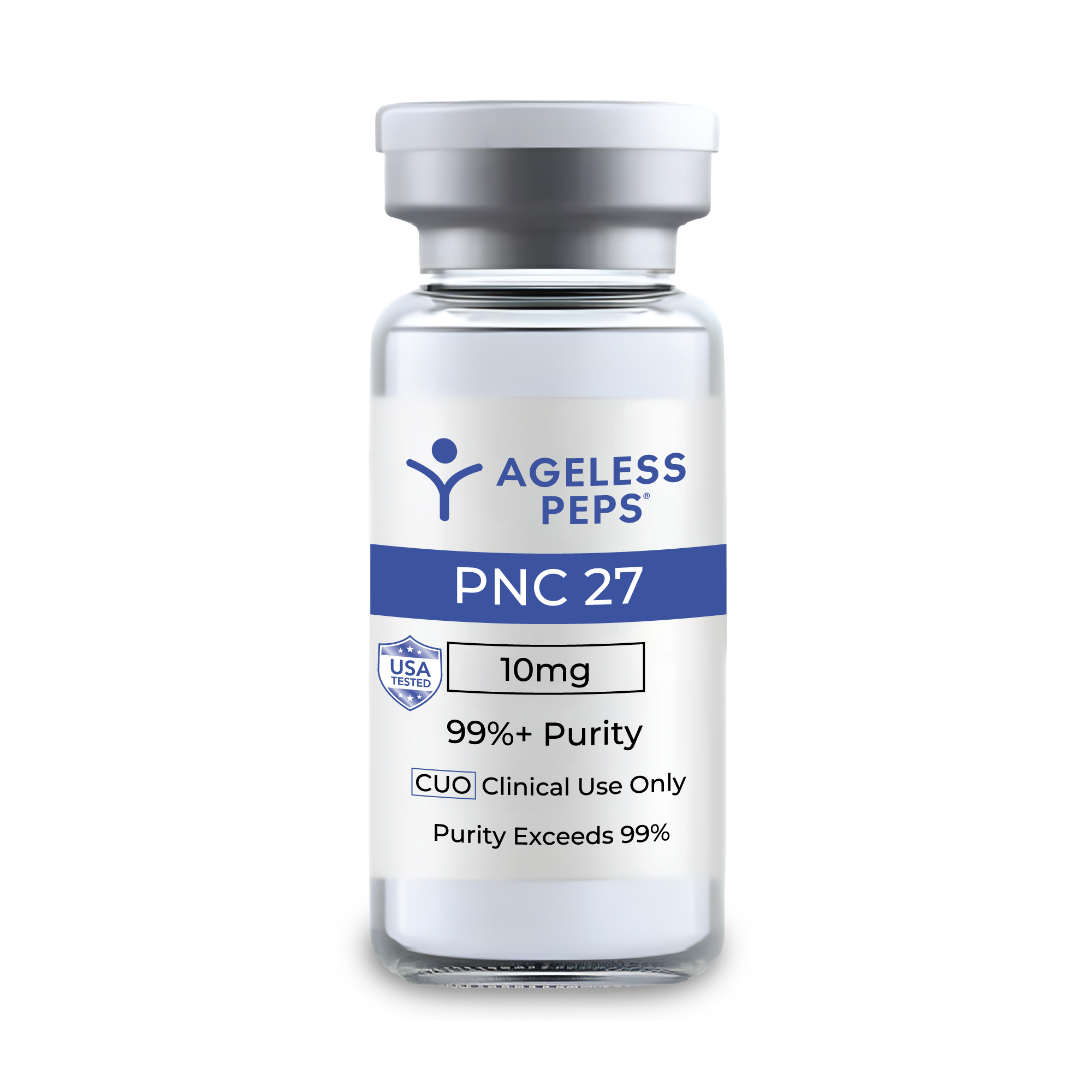
PNC 27 – 10mg Vial

$59.00

PNC-27 is a 32-amino-acid chimeric anticancer peptide that combines an HDM-2 binding domain derived from the p53 tumor suppressor with a cell-penetrating leader sequence. It selectively targets cancer cells expressing membrane-bound HDM-2, inducing pore formation and cell necrosis while sparing normal, untransformed cells.

In cancer biology and targeted therapy research, PNC-27 is studied for its role in selective tumor cell lysis, HDM-2/p53 interaction dynamics, membrane pore formation, and cancer-specific cytotoxicity. It serves as a key tool for investigating peptide-mediated, target-specific anticancer mechanisms in preclinical models.

$59.00

Disclaimer
Our products are sold in powder form and are typically reconstituted before use. Related materials such as syringes are not provided. Instruction for reconstitution or dosing is not included. These products are intended for research purposes only.

Molecule Profile

  • Chemical Name: PNC-27 (p53-derived Chimeric Anticancer Peptide)
  • Sequence: Pro-Pro-Leu-Ser-Gln-Glu-Thr-Phe-Ser-Asp-Leu-Trp-Lys-Leu-Leu-Lys-Lys-Trp-Lys-Met-Arg-Arg-Asn-Gln-Phe-Trp-Val-Lys-Val-Gln-Arg-Gly
  • Molecular Formula: C₁₈₈H₂₉₃N₅₃O₄₄S
  • Molecular Weight: 4031.71 g/mol
  • PubChem CID: Data pending verification
  • Solubility: Soluble in water and DMSO; reconstitution in sterile water is recommended.

Product Overview

PNC-27 is a 32-residue chimeric peptide that fuses an HDM-2 (Human Double Minute 2) binding domain—corresponding to residues 12–26 of the p53 tumor suppressor—with a cell-penetrating transmembrane leader sequence. In preclinical models, PNC-27 selectively targets cancer cells that express HDM-2 on their plasma membranes while leaving untransformed cells unaffected. This selectivity makes PNC-27 a widely studied tool in cancer biology for investigating membrane-targeted apoptotic and necrotic pathways.

Key Areas of Research

Note: The following observations are derived from preclinical models unless otherwise noted. 1. Selective Cancer Cell Lysis PNC-27 has been demonstrated to induce membranolysis specifically in cancer cells expressing HDM-2 on their surface membranes. In vitro studies across multiple cancer cell lines—including breast, pancreatic, and leukemia cells—show that PNC-27 forms transmembrane pores leading to cell necrosis, while normal cells remain viable and unaffected. 2. HDM-2/p53 Interaction Dynamics Research utilizes PNC-27 to study the binding interaction between HDM-2 and p53-derived sequences at the cellular membrane level. Structural studies indicate that PNC-27 adopts an alpha-helical conformation upon binding to membrane-associated HDM-2, providing insight into how the p53 tumor suppressor pathway can be exploited for targeted cancer cell destruction. 3. Membrane Pore Formation Mechanisms PNC-27 is used as a model compound for studying peptide-induced membrane disruption in transformed cells. Biophysical analyses suggest that pore formation is concentration-dependent and requires direct interaction with HDM-2 protein, distinguishing it from non-specific detergent-like lytic peptides. Transfection of untransformed cells with membrane-targeted HDM-2 renders them susceptible to PNC-27, confirming the target specificity. 4. Clinical Outlook As of 2026, peer-reviewed human clinical trial data specific to PNC 27 remains limited. Current evidence is derived primarily from preclinical models (in-vitro cell culture and in-vivo animal studies). Researchers continue to investigate this compound’s translational potential, and early-stage clinical evaluations may be underway. Consult published literature and clinical trial registries (e.g., ClinicalTrials.gov) for the most current status.

Storage & Handling Guidelines

  • Lyophilized (Powder): Stable at room temperature for shipping (up to 3 weeks). Store at -20°C for long-term stability (12–24 months). Keep desiccated and protected from light.
  • Reconstituted (Liquid): Store at 4°C (39°F).
  • Stability: Use within 2–7 days of mixing. Do not shake during reconstitution; gentle swirling is required.

Storage Instructions

Our products are made using a freeze-drying (lyophilization) process, which helps keep them stable during shipping for up to 3–4 months.

When the peptide is in its dry powder form, it can be stored at room temperature until you are ready to use it.

Once the peptide is mixed with bacteriostatic water (reconstituted), it should be stored in the refrigerator to maintain freshness and effectiveness. After mixing, the peptide will remain stable for up to 30 days when kept refrigerated.

Freeze-drying works by removing moisture while the peptide is frozen, leaving behind a dry, white powder that stays stable until it is rehydrated. This process helps protect the peptide and extend its shelf life.

After receiving your order, keep peptides away from direct light and heat. If you plan to use them within a few weeks or months, refrigeration below 4°C (39°F) is recommended, though short-term room-temperature storage is generally acceptable for dry peptides.

For long-term storage (several months to years), peptides should be kept in a freezer at −80°C (−112°F) to best preserve their quality and stability.

No COA available for this product.

Important: All peptides offered are intended for in-vitro and pre-clinical research only. Not for human use. Not approved by the US FDA for medical conditions.

Peptides are short chains of amino acids, typically under 50 residues, whereas proteins are much longer and fold into complex structures.
Because peptides are smaller, they tend to:

  • Bind more selectively to receptors

  • Have faster biological signaling effects

  • Be easier to synthesize and modify for research
    This makes them ideal for targeted experiments in regeneration, metabolism, and cellular communication.

  • Ageless Pep provides high-purity, lab-tested research peptides.

  • The team is dedicated to scientific accuracy and excellent customer support.

  • The platform serves a community of researchers and scientists committed to innovation.

Depending on the study design, peptides can be researched through:

  • In-vitro assays

  • Animal models

  • Cell cultures

  • Subcutaneous or intravenous administration (in animals)

Each peptide behaves differently — for example, Semaglutide and Tirzepatide are studied via subcutaneous injections, while others like BPC-157 show effects even when administered orally or parenterally in rodent studies.

Peptides generally require:

  • Cool, dry storage when lyophilized

  • Refrigeration after reconstitution

  • Protection from UV light and temperature fluctuations

This preserves molecular integrity, preventing oxidation or breakdown of amino-acid chains.
Proper storage ensures reproducibility of experimental results.

High-quality research peptides often exceed 98–99% purity, validated through HPLC and Mass Spectrometry.
The guide notes Ageless Pep’s commitment to lab-tested, high-purity peptides verified through strict protocols.
Peptide bioavailability depends on:
  • Molecular weight
  • Receptor affinity
  • Use of fatty-acid modifications (e.g., GLP-1 di-acid component for long-acting effects)
  • PEGylation to extend half-life (e.g., PEG-MGF)
  • Route of administration
  • Enzyme resistance (e.g., BPC-157’s stability in gastric acid)
Peptides like GLP-1 and GLP-2 activate GLP-1 and GIP receptors, influencing:
  • Appetite regulation
  • Insulin secretion
  • Gastric emptying
  • Blood glucose stabilization
  • Energy expenditure
Multiple clinical trials cited in the guide show significant reductions in HbA1c, body weight, and cardiometabolic markers
Depending on the study design, peptides can be researched through:
  • In-vitro assays
  • Animal models
  • Cell cultures
  • Subcutaneous or intravenous administration (in animals)
Each peptide behaves differently — for example, GLP-1, GLP-2 AND GLP-3 are studied via subcutaneous injections, while others like BPC-157 show effects even when administered orally or parenterally in rodent studies.

Our products are made using a freeze-drying (lyophilization) process, which helps keep them stable during shipping for up to 3–4 months.

When the peptide is in its dry powder form, it can be stored at room temperature until you are ready to use it.

Once the peptide is mixed with bacteriostatic water (reconstituted), it should be stored in the refrigerator to maintain freshness and effectiveness. After mixing, the peptide will remain stable for up to 30 days when kept refrigerated.

Freeze-drying works by removing moisture while the peptide is frozen, leaving behind a dry, white powder that stays stable until it is rehydrated. This process helps protect the peptide and extend its shelf life.

After receiving your order, keep peptides away from direct light and heat. If you plan to use them within a few weeks or months, refrigeration below 4°C (39°F) is recommended, though short-term room-temperature storage is generally acceptable for dry peptides.

For long-term storage (several months to years), peptides should be kept in a freezer at −80°C (−112°F) to best preserve their quality and stability.